Built-in hob vs gas stove: care and service every 6 months
What to clean at home on a gas stove and on a built-in hob, what to leave alone, and what a proper six-monthly service should cover in an Indian kitchen.
A built-in hob and a countertop gas stove burn the same gas through very similar burners. What differs is everything around the flame: where the parts sit, what gets wet when you clean, and what wears out. That changes how you should look after each one at home, and why both benefit from a proper service about every six months in an Indian kitchen.
Why six months, not “when it breaks”
Most manufacturers suggest a yearly service. In a home that cooks two or three meals a day with tadka, deep frying and boil-overs, burners and jets clog faster than that. North India adds fine dust in the dry months before the monsoon, and damp during it, which corrodes brass and steel parts and ignition contacts. So our advice is a service every six months in a busy Indian kitchen, and at least once a year in a light one. A visit before summer and another before the festival season catches a slow jet, a stiff knob or an old hose before it becomes a weak flame or a leak.
The countertop gas stove: daily and weekly care
- After cooking, once the stove is cool, wipe the top with a damp cloth and dry it. On a glass-top stove, never put cold water or a wet cloth on hot glass, which can crack it.
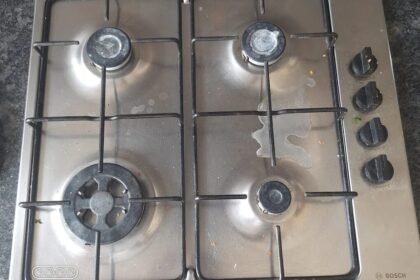
- Spills on burners: lift the burner cap and ring when cold, brush away food with a dry, soft brush, and wipe. If you wash them, dry them completely before refitting, and put each cap back on the burner it belongs to.
- Do not soak the stove itself, spray cleaner straight onto the knobs or pour water on the top. Liquid runs down the knob spindles into the valves and the ignition.
- Battery ignition: if the click has gone slow, change the battery before it leaks. Check the holder for crust once in a while.
- The hose: keep it away from the hot body of the stove, check it is not kinked behind the stove, and read its expiry date when you change the cylinder.
- The regulator: turn it off at night and when you leave the house, not just the knobs.
The built-in hob: what is different
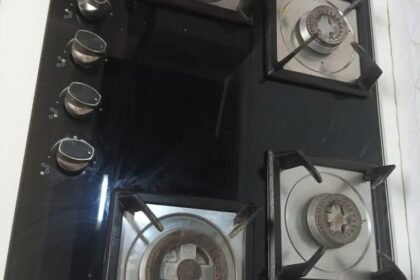
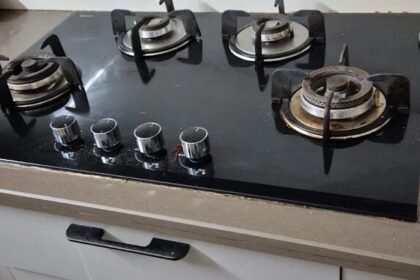
A hob is sealed into a cutout in the counter. Its valves, ignition wiring and gas connection are underneath, reached from the cabinet below. That makes three habits matter more than on a stove.
- Keep liquid out of the knobs. On a stove, a spill runs off the top. On a hob, it can run around the knob and down onto the ignition switches and electrics under the glass. Wipe spills near the knobs immediately, and never flood the glass to clean it.
- Keep the cabinet below clear and ventilated. It holds the hob’s gas connection and usually its power socket. Do not pack it with bags, chemicals or paper. Do not keep the LPG cylinder in it: LPG is heavier than air, so a leak pools there, next to the hob’s socket. The cylinder belongs upright at floor level in a ventilated spot. If there is truly no other place, the cabinet needs permanent vents at the bottom and its door open while you cook. See where gas leaks start.
- Know how it sparks. Hobs come with mains or battery ignition. Before a thorough clean, switch a mains hob off at the socket; on a battery hob, change the cell when the click goes slow, before it leaks.
Most hobs also have a flame-failure device at each burner, a small metal probe that shuts off gas if the flame goes out. Keep it clean with a dry cloth, never bend it, and never wedge a knob to get around it. If a burner goes out when you let go of the knob, read our piece on the flame-failure device.
For both: you can clean the top, the burner caps and the rings, and change an ignition battery. Anything involving the jets, the valves, the regulator, the hose fittings, the pipeline or the wiring is a technician’s work.
What a six-month service covers
A proper service is more than a wipe-down. On a gas stove or a hob, it should include:
- Burners stripped and cleaned, including the mixing tubes and the jets, cleared with the correct tool rather than a pin.
- Flame set on each burner so it is blue and steady, with the air setting adjusted where needed.
- Knob valves cleaned and greased, so the knobs turn smoothly and close fully. Stiff knobs are common on stoves that have never had this done.
- Ignition tested: the battery holder or power supply, the module and each electrode.
- Flame-failure devices tested on a hob, and on stoves that have them.
- Gas supply checked: the regulator, the hose and its date, the clips, and on piped gas the valves. Every joint is tested with soap solution.
- For a hob, the gas connection and the power socket under the counter checked, and the hob’s seal looked at if the hob has to come out.
To make the visit quicker, clear the counter (and for a hob, the cabinet underneath) and keep the model sticker or manual handy.
Repairs are a different job too
On a stove, a technician can often lift the whole appliance onto a table and work on it in one piece. A hob is usually worked on from the cabinet below, or lifted out of the counter, so the same fault takes longer. We have written about why in built-in hob vs gas stove: why repairs are a different job.
Do the chimney in the same visit
The chimney above the hob or stove sits in the same grease. If its suction has dropped (“chimney ka suction kam ho gaya”), oil drips back down onto the burners and the hob glass, and the burners clog faster. Booking a chimney service on the same day means one visit, one clean-up and a kitchen that stays clean for longer.
Brands we see most
The care above applies to every make. For the faults we see most on particular brands, see Sunflame hob repair, Prestige hob repair, Faber gas stove repair and Hindware gas stove repair. We are an independent service, not any brand’s authorised service centre; for an appliance still under the maker’s warranty, call the maker first.
When it is time for the six-monthly check, book a hob service or book a gas stove service. A visiting charge applies, and the technician tells you the cost of any part before fitting it.
Want this done?
Hob & Built-in Hob Repair across Chandigarh, Mohali, Panchkula, Zirakpur, Delhi, Faridkot, Gurugram, Noida, Pune. No advance — you pay after the job.
Book Hob & Built-in Hob RepairCall +91 92708 07381