Gas leak at a stove or hob: where it starts and how it is fixed
How to tell a real leak from a normal whiff, where leaks start at a gas stove or a built-in hob in an Indian kitchen, and what a proper leak repair should include.
This guide is about finding and fixing a gas leak at a stove or a built-in hob: how to tell a leak from a normal whiff, where in an Indian kitchen it usually starts, and what a proper repair involves. If you can smell gas right now, stop reading here and deal with that first.
Smelling gas now? Do not light anything. Do not touch any electrical switch, on or off, not even the exhaust fan or the chimney. Close the regulator on the cylinder or the PNG valve near the stove, open the doors and windows, get everyone out and call from outside: 1906 for LPG, or your gas company’s emergency number for piped gas (it is on the bill and on the sticker near the meter). Our first-minute checklist explains each step.
Is it really a leak?
A faint smell for a moment when a burner takes a few seconds to light is unburnt gas from that attempt, and it clears within a minute with the window open. A brief smell while the cylinder is being changed is also normal. Everything else should be treated as a leak:
- A smell that is there with every burner off
- A smell that comes back after airing the kitchen
- A smell strongest near the cylinder, the regulator, the hose, behind the stove or in the cabinet under a hob
- A hissing sound anywhere on the gas line
Cooking gas has no smell of its own; a strong-smelling chemical is added so you notice it early. That also means a very slow leak in a breezy kitchen can go unnoticed. Two quieter signs are worth taking seriously: a cylinder that runs out clearly sooner than it used to with the same cooking, and a smell that appears only when the regulator is first turned on in the morning.
Where the gas collects tells you where to look
LPG is heavier than air. It sinks, spreads along the floor and collects in low corners and in closed cabinets. A smell that is strongest when you bend down, or when you open the cabinet under the platform, points to the cylinder, the regulator or the hose at the bottom of the line.
Piped natural gas is lighter than air. It rises and gathers near the ceiling and at high ventilators. On a PNG line, a smell near the meter or along the pipe at head height points to a pipeline joint rather than the stove.
Use this only to tell the technician or the gas company where you noticed it. Finding the exact spot is their job, done with soap solution or a detector, never with a flame.
Where leaks usually start
Between the cylinder or meter and the burner there are only a few places gas can escape. In the kitchens we work in across the tricity, we find them in roughly this order:
- The rubber hose. Rubber hardens and cracks with heat and age, usually at the ends or on the underside where nobody looks. Every approved hose has an expiry date printed on it. Our gas pipe safety guide explains what to look for.
- The regulator, when it is not seated properly on the cylinder valve or the rubber washer inside the cylinder valve is worn or missing. This is the most common leak right after a cylinder change.
- The joints where the hose meets the regulator and the stove, especially when the clip is loose or missing, or the hose has been pulled tight.
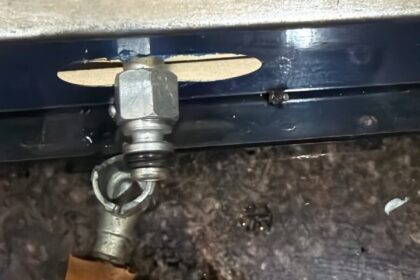
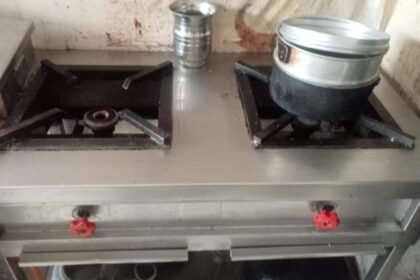
- The stove’s own knob valves, when a knob does not close fully. Old stoves whose valves have never been cleaned and greased are the usual case; the smell sits near the knobs with the stove off.
- Pipeline joints on a piped-gas or copper line, particularly after kitchen renovation or modular kitchen work.
A built-in hob adds a hidden joint
On a countertop stove you can see the whole line. On a built-in hob, the gas enters through an inlet elbow under the glass, reached only from the cabinet below, and the hose or pipe runs through that cabinet. That cabinet usually also holds the hob’s power socket. So a leak under a hob is both harder to notice and closer to a spark. If the smell is strongest when you open the cabinet door, leave the door open, do not switch the socket, and treat it as a leak at the hob’s inlet until it has been tested.
Hobs fitted by a carpenter during kitchen work are worth a check even if nothing smells: a hose bent sharply around a drawer runner or pinched against the back panel wears through over time.
What fixing it involves
Once the gas company or distributor has made the supply safe, do not reconnect the stove and carry on. Whatever leaked once will leak again unless the part is changed. A leak repair visit should include:
- A soap-solution test on every joint, from the cylinder or meter to each burner, before anything is touched
- The leaking part replaced, not taped: a hose, a clip, a washer, a valve
- The hose and the regulator dates read, and an expired hose replaced with an approved one
- Each knob valve tested to make sure it closes fully, then cleaned and greased
- For a hob, the inlet connection under the counter tested, lifting the hob where needed
- A final soap test on every joint, done in front of you
If the leak was on the pipeline itself rather than the stove, ask for a gas pipeline check instead. Pipeline work should always end with a pressure test as well as a soap test.
Habits that prevent most leaks
- Turn the regulator off at night and when you go away, not just the knobs
- Keep the hose away from the hot body of the stove, and do not let it hang behind the burners or run under the platform where it gets kicked
- Keep the cylinder upright, at floor level, in a ventilated place, never lying down and not shut inside a closed cabinet
- Do not let anyone without the right training change the regulator or the hose
- Have the stove or hob serviced every six months in a busy kitchen, and at least once a year, which is when a worn hose or a weak valve gets caught
When everything is safe and you want the stove and its connections tested and fixed, book a gas stove leak check. A visiting charge applies, and you are told the cost of any part before it is fitted.
Want this done?
Gas Stove (Chulha) Repair across Chandigarh, Mohali, Panchkula, Zirakpur, Delhi, Faridkot, Gurugram, Noida, Pune. No advance — you pay after the job.
Book Gas Stove (Chulha) RepairCall +91 92708 07381