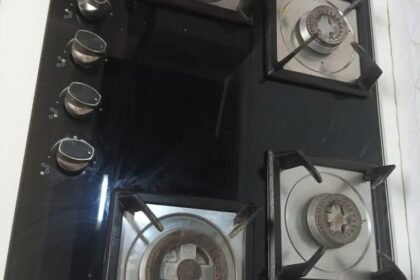
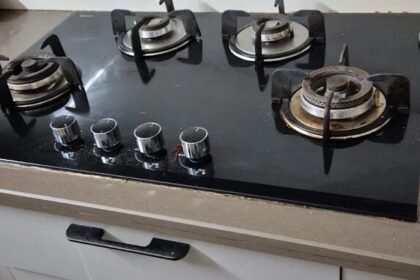
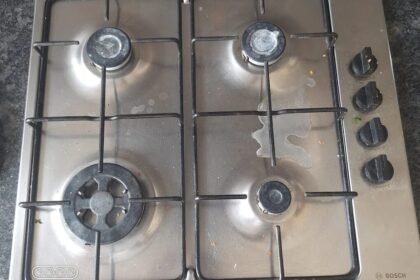
Burner pops when turned off: flashback on hobs and gas stoves
On this page (7)
What the small bang at turn-off is, which pops are harmless, which mean the burner, jet or gas setting is wrong, and what is safe to clean yourself.
You turn the knob off and the burner answers with a small “phat”. Sometimes it is a soft pop, sometimes a sharp crack that makes everyone in the kitchen jump. On hobs and gas stoves alike, this sound is common enough that most people ignore it. Often it is harmless. Sometimes it is the first sign of a burner or a gas setting that is wrong. This article explains what the pop is, which kinds are normal, and which mean the burner should be checked.
What the pop actually is
Inside every burner, gas and air mix in a short tube before they reach the ports where the flame sits. While the flame burns, the mixture moves out of the ports faster than the flame can travel back into them, so the flame stays on top. When you turn the knob off, the flow slows down for an instant. If the flame can briefly travel back into the ports faster than the mixture is coming out, it ignites the small amount of mixture still inside the burner head. That tiny ignition is the pop.
Technicians call this flashback or an extinction pop. A faint pop at turn-off is something many burners do now and then. What matters is how loud it is, how often it happens, and whether anything else is wrong.
Usually harmless
- A soft pop only when you turn the knob off quickly.
- It happens on one burner more than the others, but the flame is blue, steady and the right size while cooking.
- It goes away if you turn the knob down to low for a second before turning it off.
Turning to the lowest setting first, then off, is a good habit on any burner: the flow slows gently and there is less mixture left to ignite.
Worth getting checked
- A loud bang or crack, especially if it is getting louder over weeks.
- A pop when you light the burner, rather than when you turn it off. A delayed ignition, where gas builds up for a moment before it catches, is more serious: it means gas is collecting before the spark reaches it.
- A flame that “roars” or burns with a hiss, or that lifts off the burner and flutters.
- The flame burning inside the burner or down at the jet, below the cap, rather than at the ports. You may see a glow under the cap or hear a steady whistle. Turn it off at once.
- Yellow or orange flames with the popping. Read what an orange flame means.
- Popping that started right after a cleaning, a new cylinder, a regulator change, or a switch from LPG to PNG.
The usual causes
- Burner cap not seated properly. After cleaning, a cap that sits slightly crooked changes how the flame and the mixture behave at the ports. Lift it off and place it back so it sits flat and does not rock.
- Dirty or blocked ports. Food and spilt milk in some ports make the flame uneven and let it pull back more easily on others. Our article on an uneven flame on one burner covers this.
- Wet burner parts. A burner head put back damp after washing can sputter and pop until it dries fully.
- The wrong jet for the gas. LPG and PNG need different jet sizes. A stove or hob converted without the right jets, or with the air setting left as it was, often pops, roars or lifts. See what changes from LPG to PNG.
- A worn or enlarged burner head. Years of scrubbing with wire brushes, or corrosion, can widen the ports. Wider ports let the flame travel back more easily.
- Gas pressure that is not right, from a regulator problem. This tends to show on every burner, not just one.
What you can do yourself
With every knob off and the burners cool:
- Lift the cap and burner head of the popping burner and look for food in the ports. Clean them with a soft brush and warm soapy water, rinse, and let them dry completely, ideally for a few hours.
- Put them back exactly as they came out, cap flat and centred.
- Do not poke the ports with a pin or a wire. That enlarges them and makes popping worse.
- Turn to low before off, and see if the pop changes.
Do not touch the jet, the gas valve, the air shutter or the regulator. Do not remove the burner base or loosen anything under it. Those parts decide how much gas flows and where; changing them without the right tools and a leak test is how a small nuisance becomes a real danger.
Is popping dangerous?
A soft pop at turn-off with an otherwise normal flame is a nuisance, not an emergency. A burner that pops at ignition, burns inside, or keeps getting louder is a different matter: it means gas and flame are not where they should be. Stop using that burner, keep the others in use only if they behave normally, and get it checked.
On a hob, the flame-failure device beside each burner adds one more variable. If a burner pops and then goes out, or keeps cutting off when you release the knob, read our piece on the flame-failure device.
Questions people ask
Gas band karte waqt burner mein phat ki awaaz kyun aati hai?
The flame briefly travels back into the burner and lights the little gas and air left inside it. A soft pop now and then is common. Turn to low before off. A loud or growing bang needs a check.
Burner jalate waqt dhamaka sa hota hai, kya yeh khatarnak hai?
Yes, treat it seriously. A pop or whoosh at lighting means gas collected before it caught. Stop using that burner and have the ignition and the burner checked.
Will a new burner stop the popping?
Only if the old burner head is worn or damaged. If the cause is the jet, the pressure or the cap, a new burner will pop too. Find the cause first.
If a burner on your hob or stove keeps popping, book a hob check, or a gas stove check for a freestanding stove. The technician looks at the burner, the jet and the connection together. A visiting charge applies, and you are told the cost of any part before it is fitted.
Want this done?
Hob & Built-in Hob Repair across Chandigarh, Mohali, Panchkula, Zirakpur, Ahmedabad, Dehradun, Delhi, Faridkot, Gurugram, Indore, Ludhiana, Mumbai, Noida, Pune. No advance — you pay after the job.
Book Hob & Built-in Hob RepairCall +91 92708 07381