Choosing a built-in hob for an Indian kitchen: what to check before you buy
Burner mix, pan supports for a kadhai, glass or steel, flame-failure devices, battery or mains ignition, LPG or PNG jets, and the cutout: a practical checklist.
Most people choose a built-in hob from a showroom display: the glass looks good, the knobs feel solid, and the salesperson says “4 burner best hai”. A year later the same people find that the big kadhai wobbles on the pan supports, the simmer is too strong for milk, or the hob does not fit the cutout their carpenter made. This is a practical checklist for choosing a hob that suits Indian cooking and is easy to service later. It does not recommend any brand; it tells you what to look at.
Count your burners by how you cook, not by the box
Three burners are enough for most families of three or four. A fourth burner helps if two people cook at once, or if you regularly run a pressure cooker, a tawa, a kadhai and a chai pan together. What matters more than the count is the mix:
- One large burner (often a double- or triple-ring) for the kadhai and big pressure cookers.
- Two medium burners for everyday dal, sabzi and the tawa.
- One small burner that can hold a truly low flame for milk, tea and slow cooking.
Light every burner in the showroom if they allow it, or ask to see a working unit. Turn each to its lowest setting: a good simmer is small and steady, not flickering.
Pan supports matter more than the glass
Indian cooking puts heavy, round-bottomed vessels on a hob: kadhai, handi, a full five-litre cooker. Look for:
- Heavy cast-iron pan supports that sit firmly and do not rock.
- Supports close enough together that a small milk pan does not tip, and wide enough that a large kadhai sits level.
- A wok stand or a deeper support for the big burner if you cook in a round-bottomed kadhai often.
Place one of your own vessels on the display if you can. A wobble in the showroom will be worse with oil in the pan.
Glass or steel top
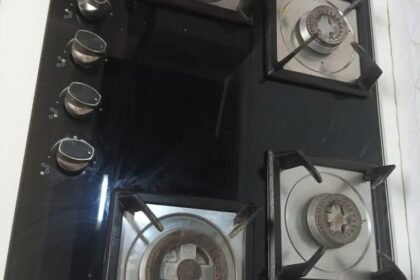
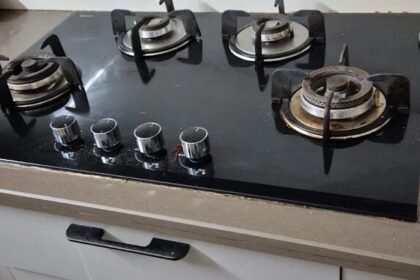
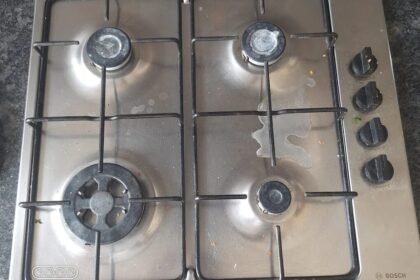
Toughened glass is easy to wipe and looks clean, but it shows every water mark and can crack from a heavy drop or a sudden temperature shock. Stainless steel hides small scratches, takes knocks better, but shows fingerprints and needs more scrubbing around the burners. Neither is “better” for every kitchen. If you fry a lot and handle heavy vessels, steel is more forgiving. If you want an easy wipe-down, glass is fine as long as you treat it with a little care; we have written about what happens when glass cracks.
Safety features to insist on
- Flame-failure device on every burner. A small probe beside each burner that shuts the gas if the flame goes out, from a boil-over or a draught. It is the single most useful safety feature on a hob. Read how it works.
- Knobs that need a push before they turn. Children and elbows cannot turn them on by accident.
- Certification. Check the product carries the marks and the documents required for gas appliances sold in India, and keep the manual.
Ignition: battery or mains
Hobs make their spark either from a battery cell (often one AA or D cell) or from a mains socket in the cabinet below. Battery ignition keeps working in a power cut and needs only a fresh cell once in a while. Mains ignition needs a switched socket in the cabinet, placed away from the gas connection. Ask which one the hob uses before you buy, so the carpenter and electrician can plan for it.
LPG or PNG
The gas jets (nozzles) in a hob are sized for one gas. If you cook on LPG now but expect a piped gas connection soon, ask whether the hob comes with PNG jets or whether they can be supplied, and who changes them. Running a hob on the wrong jets gives a yellow, lifting or roaring flame. See what changes when you move from LPG to PNG.
Fit and the cabinet below
- Cutout size. Every hob has its own cutout size in the manual. If you are replacing an old hob, measure the existing cutout first. Our article on a new hob that does not fit the old cutout covers what needs to change.
- Ventilation. The cabinet under the hob needs openings so that any gas cannot collect there, and space to reach the gas connection and its valve without emptying the cabinet.
- Distance to the chimney. A chimney should be the same width as the hob or wider, at the height its manual gives.
- The gas connection. A short, visible hose or a proper fixed connection, as the manual describes. Never a long hose snaking through drawers.
Think about service on the day you buy
A hob is worked on from the cabinet below or by lifting it out of the counter, which takes longer than a freestanding stove. Make it easier for the future: leave the cabinet below reachable, keep the manual and the purchase bill together, note the model number, and do not seal the hob in with silicone all round unless the manual asks for it.
Questions people ask
Hob lena chahiye ya normal gas stove?
Both cook equally well. A hob gives a flush counter and is easier to keep clean around, but its repairs take longer and the cabinet below needs planning. A stove is simpler to move, clean underneath and repair. Our piece on why repairs are a different job explains the trade-off.
Is a 90 cm hob better than a 60 cm one?
Only if your counter has the space and you use the extra burner. A wider hob spaces vessels better, but it also needs a wider chimney and a wider cutout.
Kya hob ki installation khud kar sakte hain?
No. Placing a hob in a cutout looks simple, but the gas connection, the hose and the leak test are a technician’s job. A wrong fitting or an untested joint is a gas leak waiting to happen.
When your new hob arrives, or if your current hob needs a check, book a hob visit. The technician connects or checks it and tests every joint for leaks. A visiting charge applies, and you are told the cost of any part before it is fitted.
Want this done?
Hob & Built-in Hob Repair across Chandigarh, Mohali, Panchkula, Zirakpur, Delhi, Faridkot, Gurugram, Noida, Pune. No advance — you pay after the job.
Book Hob & Built-in Hob RepairCall +91 92708 07381